Four main application for activated alumina
Time:2026-07-23
Activated alumina is not a single product, but a series of materials with significant functional differences. For procurement, production manager, and technical managers, understanding the performance logic behind different application is the key to controlling costs and ensuring process stability. Starting from application scenarios, this article analyzes the core technical parameters and selection points of activated alumina.
One. The essence of activated alumina: porous structure determines function
The industrial activated alumina refers to γ - Al₂O3 and its mixed crystal forms, which are obtained by dehydration of hydrated alumina (pseudo boehmite) through heat treatment. Its core value lies in its high specific surface area (usually between 250-340 m²/g) and rich microporous structure, which endows it with strong adsorption capacity and catalytic activity.
However, it should be noted that specific surface area, pore size distribution, bulk density, and crush strength are interrelated and mutually restrictive indicators. There is no universal activated alumina, the essence of selection is to find the parameter combination that best matches the application scenario.
Two. Four main applications and key technical parameters
1. Desiccants and adsorbents: Pursuing high water absorption and low dew point
This is the most widely used application direction, commonly used for compressed air drying, instrument air drying, and deep dehydration of petrochemical gases (such as cracking gas and methane hydrogen)
* Static adsorption capacity (RH=60%): A core indicator for measuring water absorption capacity, with high-quality products in the industry reaching over 17%.
* Bulk density: Affects the loading capacity and equipment size directly, commonly ranging from 0.65 to 0.75 g/ml.
* Crush strength: Determines the service life and wear resistance, generally requiring ≥ 100 N/piece.
*Regeneration temperature: Usually between 180-250 ℃, which is an important source of its economy.
Selection suggestion: For applications with strict dew point requirements , such as the electronics industry, which requires temperatures below -40 ℃, priority should be given to items with a specific surface area of ≥ 280 m ²/g and moderate pore volume. When purchasing, attention should be paid to the wear rate (preferably ≤ 0.3%), which directly affects the frequency of dust carryover and replenishment.
2. Fluoride removal agent: Pay attention to adsorption capacity and pH adaptability
Used for defluorination of drinking water or industrial wastewater, activated alumina is an important application in the field of environmental protection
*Fluoride absorption capacity: usually requires ≥ 2.0 mg/g, and high-end products can achieve even higher levels
*Particle size: Small particle sizes (such as 1.0-2.0 mm) are commonly used to increase contact area, but strength needs to be balanced.
*Chemical stability: Attention should be paid to the influence of the pH value of the raw water on the adsorption effect, and the optimal pH is usually 5-6.
Selection suggestion: The fluoride removal project for drinking water should pay attention to whether the product meets relevant water related hygiene standards. The cost of regeneration (consumption of sodium hydroxide or aluminum sulfate) is an important consideration during the operational phase.
3. Catalysts and carriers: Specific surface area and pore size distribution determine activity
*This is the application field with the highest technological content and added value, covering petroleum hydrocracking, hydrorefining, reforming, dehydrogenation reactions, as well as automobile exhaust purification.
*Specific surface area and pore volume: Typically, a specific surface area of ≥ 300 m ²/g and a pore volume of ≥ 0.40 ml/g are required to provide sufficient attachment sites for the active component.
*Pore size distribution: More important than surface area, but pore size distribution is more critical. Different reactions require different pore sizes-- Small pore alumina is suitable for certain fine reactions, while mesoporous and macroporous alumina are used for catalytic processes involving large molecules.
*Purity: The content of impurities (especially Na ₂ O) needs to be strictly controlled. Industry standards usually require ≤ 0.4%, and some high-end applications even require ≤ 0.04%.
When purchasing such products, it is not enough to only look at the Al₂O3 content. Suppliers must be required to provide specific surface area, pore volume, average pore size, etc. Both catalyst carriers, used for hydrogen peroxide and for automotive exhaust treatment products, have essential differences in pore structure.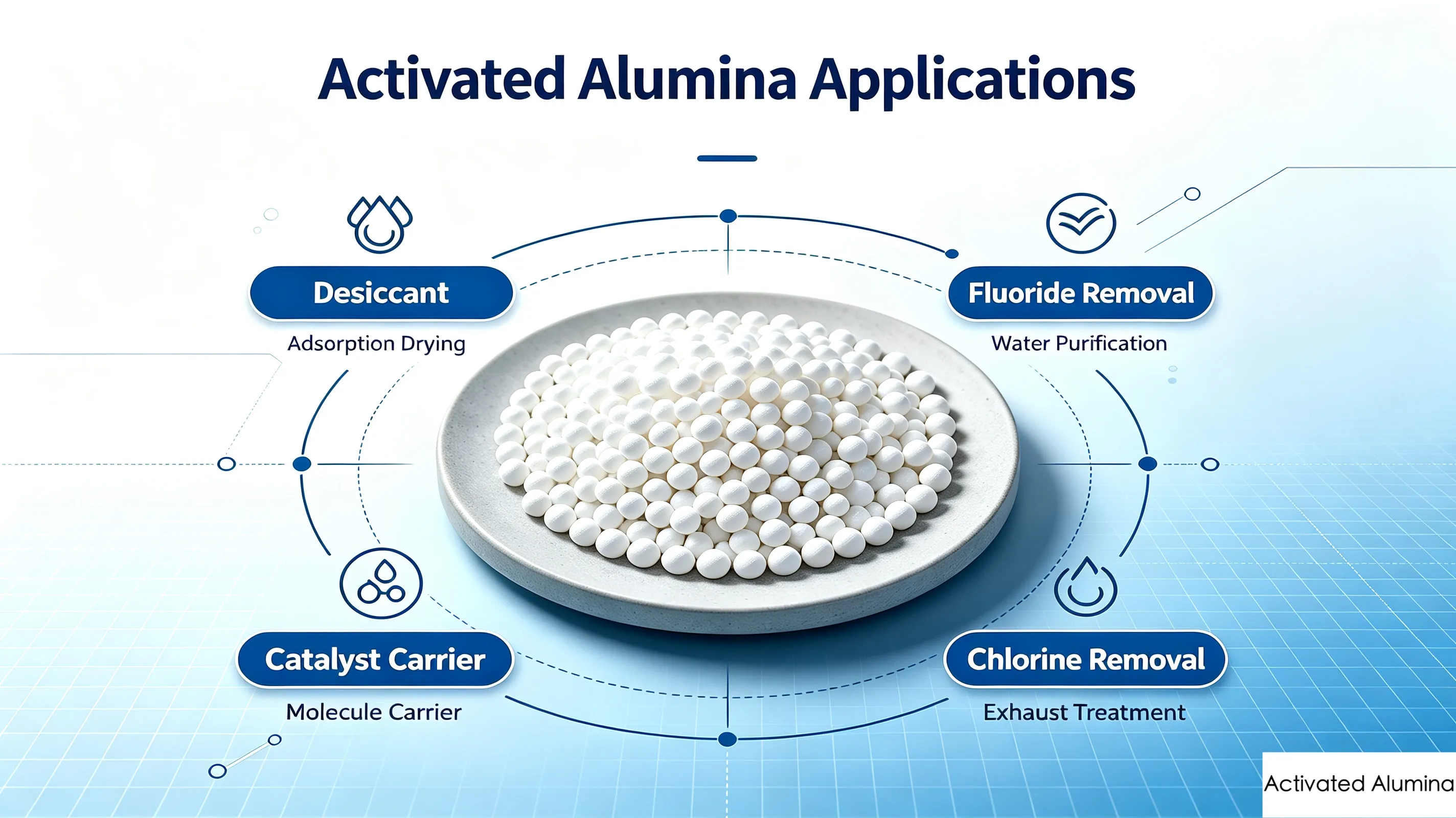
4. Special purpose: Dechlorination agent
Specialized products for specific processes, such as dechlorination agents, are usually formulated on basic activated alumina.
Activated alumina is a typical industrial material with "one parameter, one performance". Whether it is drying to remove water, purifying to remove fluoride, or catalytic conversion, successful applications all begin with precise matching of process requirements and material parameters. It is recommended that the procurement, production, and technology departments work together to translate process requirements into specific and quantifiable technical indicators, which can be used as a basis for supplier screening and evaluation.
We specializes in the production of activated alumina, molecular sieves, and other adsorbents for 16 years. We have a mature team to assist customers in handling different projects. Welcome new and regular customers to inquire.
Activated alumina is not a single product, but a series of materials with significant functional differences. For procurement, production manager, and technical managers, understanding the performance logic behind different application is the key to controlling costs and ensuring process stability. Starting from application scenarios, this article analyzes the core technical parameters and selection points of activated alumina.
One. The essence of activated alumina: porous structure determines function
The industrial activated alumina refers to γ - Al₂O3 and its mixed crystal forms, which are obtained by dehydration of hydrated alumina (pseudo boehmite) through heat treatment. Its core value lies in its high specific surface area (usually between 250-340 m²/g) and rich microporous structure, which endows it with strong adsorption capacity and catalytic activity.
However, it should be noted that specific surface area, pore size distribution, bulk density, and crush strength are interrelated and mutually restrictive indicators. There is no universal activated alumina, the essence of selection is to find the parameter combination that best matches the application scenario.
Two. Four main applications and key technical parameters
1. Desiccants and adsorbents: Pursuing high water absorption and low dew point
This is the most widely used application direction, commonly used for compressed air drying, instrument air drying, and deep dehydration of petrochemical gases (such as cracking gas and methane hydrogen)
* Static adsorption capacity (RH=60%): A core indicator for measuring water absorption capacity, with high-quality products in the industry reaching over 17%.
* Bulk density: Affects the loading capacity and equipment size directly, commonly ranging from 0.65 to 0.75 g/ml.
* Crush strength: Determines the service life and wear resistance, generally requiring ≥ 100 N/piece.
*Regeneration temperature: Usually between 180-250 ℃, which is an important source of its economy.
Selection suggestion: For applications with strict dew point requirements , such as the electronics industry, which requires temperatures below -40 ℃, priority should be given to items with a specific surface area of ≥ 280 m ²/g and moderate pore volume. When purchasing, attention should be paid to the wear rate (preferably ≤ 0.3%), which directly affects the frequency of dust carryover and replenishment.
2. Fluoride removal agent: Pay attention to adsorption capacity and pH adaptability
Used for defluorination of drinking water or industrial wastewater, activated alumina is an important application in the field of environmental protection
*Fluoride absorption capacity: usually requires ≥ 2.0 mg/g, and high-end products can achieve even higher levels
*Particle size: Small particle sizes (such as 1.0-2.0 mm) are commonly used to increase contact area, but strength needs to be balanced.
*Chemical stability: Attention should be paid to the influence of the pH value of the raw water on the adsorption effect, and the optimal pH is usually 5-6.
Selection suggestion: The fluoride removal project for drinking water should pay attention to whether the product meets relevant water related hygiene standards. The cost of regeneration (consumption of sodium hydroxide or aluminum sulfate) is an important consideration during the operational phase.
3. Catalysts and carriers: Specific surface area and pore size distribution determine activity
*This is the application field with the highest technological content and added value, covering petroleum hydrocracking, hydrorefining, reforming, dehydrogenation reactions, as well as automobile exhaust purification.
*Specific surface area and pore volume: Typically, a specific surface area of ≥ 300 m ²/g and a pore volume of ≥ 0.40 ml/g are required to provide sufficient attachment sites for the active component.
*Pore size distribution: More important than surface area, but pore size distribution is more critical. Different reactions require different pore sizes-- Small pore alumina is suitable for certain fine reactions, while mesoporous and macroporous alumina are used for catalytic processes involving large molecules.
*Purity: The content of impurities (especially Na ₂ O) needs to be strictly controlled. Industry standards usually require ≤ 0.4%, and some high-end applications even require ≤ 0.04%.
When purchasing such products, it is not enough to only look at the Al₂O3 content. Suppliers must be required to provide specific surface area, pore volume, average pore size, etc. Both catalyst carriers, used for hydrogen peroxide and for automotive exhaust treatment products, have essential differences in pore structure.
4. Special purpose: Dechlorination agent
Specialized products for specific processes, such as dechlorination agents, are usually formulated on basic activated alumina.
Activated alumina is a typical industrial material with "one parameter, one performance". Whether it is drying to remove water, purifying to remove fluoride, or catalytic conversion, successful applications all begin with precise matching of process requirements and material parameters. It is recommended that the procurement, production, and technology departments work together to translate process requirements into specific and quantifiable technical indicators, which can be used as a basis for supplier screening and evaluation.
We specializes in the production of activated alumina, molecular sieves, and other adsorbents for 16 years. We have a mature team to assist customers in handling different projects. Welcome new and regular customers to inquire.
