4A Molecular Sieve: Characteristics, Industrial Applications, and Typical Case Analysis
Time:2026-08-05
1、What is 4A molecular sieve?
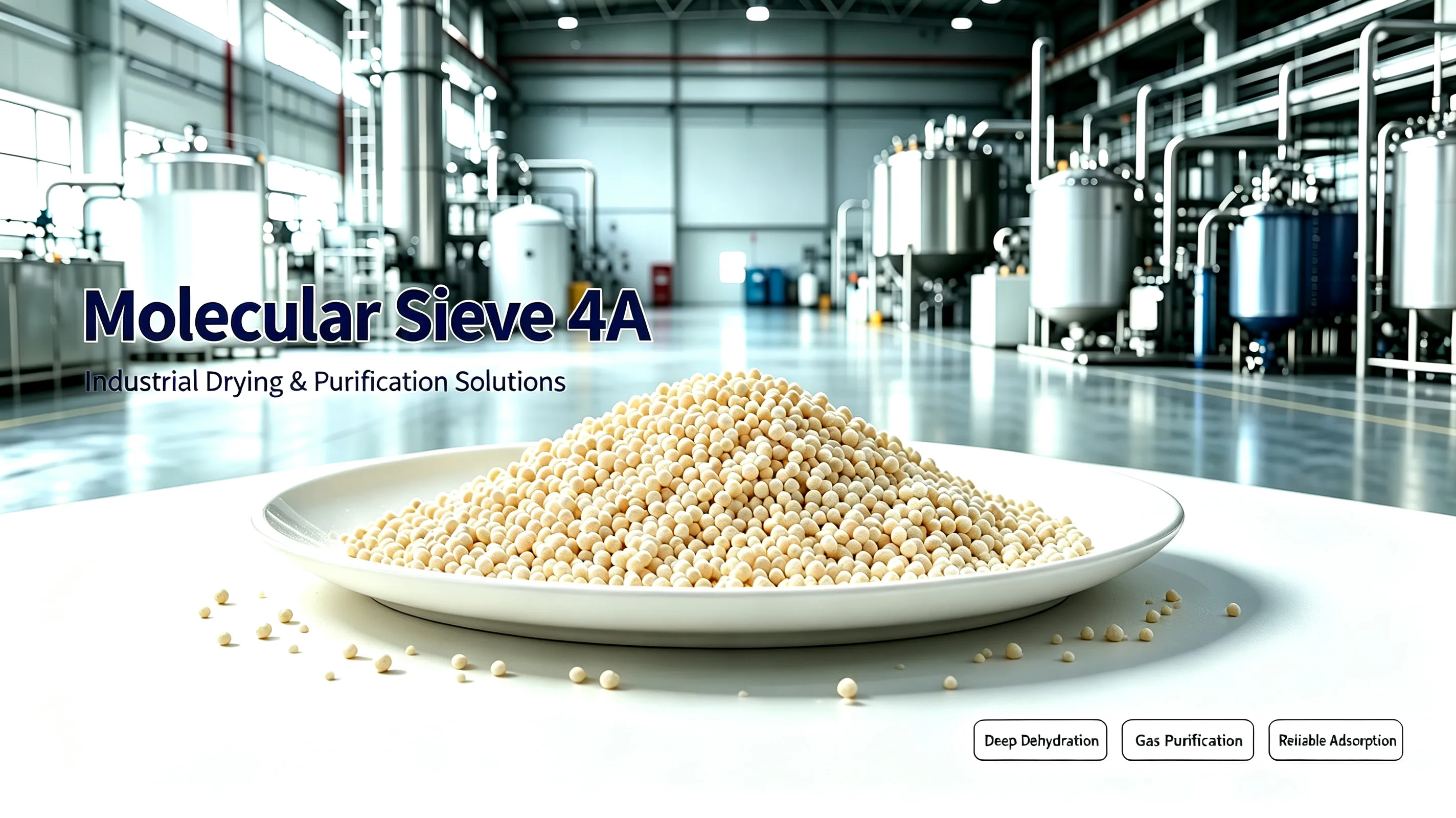
4A molecular sieve is an artificially synthesized alkali metal alumino silicate, belonging to the zeolite molecular sieve family. Its chemical formula is Na2O·Al2O3·2SiO2·9/2H2O, with a silicon aluminum ratio of approximately 2. Its core feature is uniform pore size, approximately 4Å - this size means that it only allows molecules with a critical diameter of no more than 4Å to enter its pores, while larger diameter molecules are excluded. This "sieving" ability based on molecular size is the origin of the name "molecular sieve".
At the industrial application level, there are several key characteristics of 4A molecular sieve that deserve attention:
Strong hydrophilicity: It has a higher selective adsorption capacity for water than any other molecule and is one of the most widely used molecular sieves in industry.
Cation exchange capacity: Sodium ions in the skeleton can exchange with cations such as calcium, magnesium, copper, zinc, cadmium, etc., which can be used for water softening and heavy metal removal.
Thermal stability and renewability: After adsorption saturation, it can be desorbed and regenerated by heating at 200-350 ℃ for repeated use.
2、Core application scenarios
The application of 4A molecular sieve mainly revolves around its two functions of shape selective adsorption and ion exchange.
* Deep drying of gases and liquids (Common application)
This is the main market direction for 4A molecular sieves. It can adsorb small molecules such as water, methanol, ethanol, hydrogen sulfide, carbon dioxide, ethylene, propylene, etc., but does not adsorb any molecules with a diameter greater than 4Å (including propane). This characteristic makes it particularly suitable for accurately removing trace amounts of moisture from the target material without adsorbing it.
Typical applications include: Compressed air drying, natural gas dehydration, alkane material drying, refrigerant drying, argon gas production and purification, as well as static moisture-proof drying in electronic components and pharmaceutical packaging.
* Dehydration of solvents and chemical raw materials
In the fields of fine chemicals and pharmaceuticals, many organic solvents have strict requirements for moisture content. 4A molecular sieve is widely used for deep dehydration of solvents such as ethanol, tetrahydrofuran, ethyl acetate, and dimethylhydrazine due to its strong affinity for water.
* Sewage treatment
By utilizing its cation exchange capacity, 4A molecular sieve can remove ammonia nitrogen and heavy metal ions such as lead, copper, zinc, and cadmium from wastewater.
* Catalysts and Catalyst Carriers
In the field of petrochemicals, 4A molecular sieves can also be used as selective adsorbents, catalysts, or catalyst carriers.
3、Typical Case Analysis
Case 1: Natural Gas Dehydration Unit - Optimization from pellet to Sphere
Background: The natural gas processing unit of Qiudong Oil Production Plant in Turpan Hami Oilfield of PetroChina adopts the two tower dehydration process of 4A molecular sieve. During the operation, serious pulverization of molecular sieves, reduced heat transfer capacity of the heat exchanger, and increased system resistance were encountered, which affected the efficiency of the device.
Solution: Without changing the volume of the dehydration unit and the water absorption capacity of the molecular sieve, replace the pellet 4A molecular sieve to spherical 4A molecular sieve, and increase the bulk density from 0.66 g/mL to 0.70 g/mL.
Effect: The total adsorption capacity of the dryer is increased by 3% -5%, effectively avoiding accidents where the molecular sieve bed is "penetrated" by water. At the same time, by improving the grate structure and selecting new adhesives, the amount of dust carried by dry gas has been reduced, the maintenance cycle has been extended, and considerable economic benefits have been brought.
Result: The shape (cylindrial vs. spherical) and bulk density of molecular sieves have a significant impact on the long-term stable operation of industrial equipment, and selection should not only focus on static adsorption capacity.
Case 2: Dehydration of Ethyl Acetate - Key to Particle Size Selection
Background: Ethyl acetate, as a commonly used solvent in the chemical and pharmaceutical industries, contains trace amounts of moisture that can affect product quality. The research team conducted adsorption kinetics experiments on 4A molecular sieves of different particle sizes.
Solution: 4A molecular sieve is used to adsorb trace amounts of water in ethyl acetate, and the adsorption data is fitted. The diffusion coefficient and activation energy are calculated using the Crack single pore diffusion model.
Conclusion: 4A molecular sieve has the characteristics of large adsorption capacity and high adsorption efficiency. It is recommended to use 4A molecular sieve with a particle size of 3.0-5.0 mm as the industrial ethyl acetate dehydration material.
Result: The selection of particle size for molecular sieves needs to be evaluated based on specific materials and process conditions, and not the smaller the better - particle size affects mass transfer rate and bed pressure drop, and needs to be comprehensively balanced.
Case 3: Harm Reduction of Cigarette Smoke - Application of Composite Filters
Background: The mainstream smoke of cigarettes contains low molecular weight aldehydes and ketones such as formaldehyde and acetaldehyde, which are harmful to health. Researchers have prepared chitosan molecular sieve composites and applied them to cigarette composite filters.
Solution: Compare the adsorption effects of filters with chitosan molecular sieve composite, pure 4A molecular sieve, and pure chitosan on aldehydes and ketones in flue gas.
Result: The filter with added chitosan molecular sieve composite showed good selective adsorption effect on low molecular weight aldehydes and ketones.
Inspiration: 4A molecular sieve can be combined with other materials to expand its application boundaries in the field of gas purification.
4、Precautions for use
Storage: The relative humidity at room temperature should not exceed 90%, and it should not be directly exposed to air to avoid contact with acids and alkalis.
Regeneration: When removing moisture, it is generally necessary to blow dry gas at 200-350 ℃ for 3-4 hours to reach an outlet temperature of 110-180 ℃ before cooling; When removing organic matter, it can be replaced with water vapor first, and then the water can be removed.
Selective limitation: 4A molecular sieve does not adsorb molecules with a diameter greater than 4 Å (such as propane), which is its main difference from other types of molecular sieves such as 3A, 5A, 13X, etc. When selecting, it is necessary to confirm the molecular size of the material.
The core value of 4A molecular sieve lies in the selective adsorption ability brought by its precise pore size (4 Å), especially its ultra-high selectivity for water. The areas with the highest industrial usage are deep drying of gases and liquids, followed by solvent dehydration and wastewater treatment. Actual engineering cases have shown that the physical parameters such as morphology, particle size, and bulk density of molecular sieves have a significant impact on the operational efficiency of the device, no less than the adsorption capacity itself. Therefore, selection and operational optimization are equally crucial.
1、What is 4A molecular sieve?
4A molecular sieve is an artificially synthesized alkali metal alumino silicate, belonging to the zeolite molecular sieve family. Its chemical formula is Na2O·Al2O3·2SiO2·9/2H2O, with a silicon aluminum ratio of approximately 2. Its core feature is uniform pore size, approximately 4Å - this size means that it only allows molecules with a critical diameter of no more than 4Å to enter its pores, while larger diameter molecules are excluded. This "sieving" ability based on molecular size is the origin of the name "molecular sieve".
At the industrial application level, there are several key characteristics of 4A molecular sieve that deserve attention:
Strong hydrophilicity: It has a higher selective adsorption capacity for water than any other molecule and is one of the most widely used molecular sieves in industry.
Cation exchange capacity: Sodium ions in the skeleton can exchange with cations such as calcium, magnesium, copper, zinc, cadmium, etc., which can be used for water softening and heavy metal removal.
Thermal stability and renewability: After adsorption saturation, it can be desorbed and regenerated by heating at 200-350 ℃ for repeated use.
2、Core application scenarios
The application of 4A molecular sieve mainly revolves around its two functions of shape selective adsorption and ion exchange.
* Deep drying of gases and liquids (Common application)
This is the main market direction for 4A molecular sieves. It can adsorb small molecules such as water, methanol, ethanol, hydrogen sulfide, carbon dioxide, ethylene, propylene, etc., but does not adsorb any molecules with a diameter greater than 4Å (including propane). This characteristic makes it particularly suitable for accurately removing trace amounts of moisture from the target material without adsorbing it.
Typical applications include: Compressed air drying, natural gas dehydration, alkane material drying, refrigerant drying, argon gas production and purification, as well as static moisture-proof drying in electronic components and pharmaceutical packaging.
* Dehydration of solvents and chemical raw materials
In the fields of fine chemicals and pharmaceuticals, many organic solvents have strict requirements for moisture content. 4A molecular sieve is widely used for deep dehydration of solvents such as ethanol, tetrahydrofuran, ethyl acetate, and dimethylhydrazine due to its strong affinity for water.
* Sewage treatment
By utilizing its cation exchange capacity, 4A molecular sieve can remove ammonia nitrogen and heavy metal ions such as lead, copper, zinc, and cadmium from wastewater.
* Catalysts and Catalyst Carriers
In the field of petrochemicals, 4A molecular sieves can also be used as selective adsorbents, catalysts, or catalyst carriers.
3、Typical Case Analysis
Case 1: Natural Gas Dehydration Unit - Optimization from pellet to Sphere
Background: The natural gas processing unit of Qiudong Oil Production Plant in Turpan Hami Oilfield of PetroChina adopts the two tower dehydration process of 4A molecular sieve. During the operation, serious pulverization of molecular sieves, reduced heat transfer capacity of the heat exchanger, and increased system resistance were encountered, which affected the efficiency of the device.
Solution: Without changing the volume of the dehydration unit and the water absorption capacity of the molecular sieve, replace the pellet 4A molecular sieve to spherical 4A molecular sieve, and increase the bulk density from 0.66 g/mL to 0.70 g/mL.
Effect: The total adsorption capacity of the dryer is increased by 3% -5%, effectively avoiding accidents where the molecular sieve bed is "penetrated" by water. At the same time, by improving the grate structure and selecting new adhesives, the amount of dust carried by dry gas has been reduced, the maintenance cycle has been extended, and considerable economic benefits have been brought.
Result: The shape (cylindrial vs. spherical) and bulk density of molecular sieves have a significant impact on the long-term stable operation of industrial equipment, and selection should not only focus on static adsorption capacity.
Case 2: Dehydration of Ethyl Acetate - Key to Particle Size Selection
Background: Ethyl acetate, as a commonly used solvent in the chemical and pharmaceutical industries, contains trace amounts of moisture that can affect product quality. The research team conducted adsorption kinetics experiments on 4A molecular sieves of different particle sizes.
Solution: 4A molecular sieve is used to adsorb trace amounts of water in ethyl acetate, and the adsorption data is fitted. The diffusion coefficient and activation energy are calculated using the Crack single pore diffusion model.
Conclusion: 4A molecular sieve has the characteristics of large adsorption capacity and high adsorption efficiency. It is recommended to use 4A molecular sieve with a particle size of 3.0-5.0 mm as the industrial ethyl acetate dehydration material.
Result: The selection of particle size for molecular sieves needs to be evaluated based on specific materials and process conditions, and not the smaller the better - particle size affects mass transfer rate and bed pressure drop, and needs to be comprehensively balanced.
Case 3: Harm Reduction of Cigarette Smoke - Application of Composite Filters
Background: The mainstream smoke of cigarettes contains low molecular weight aldehydes and ketones such as formaldehyde and acetaldehyde, which are harmful to health. Researchers have prepared chitosan molecular sieve composites and applied them to cigarette composite filters.
Solution: Compare the adsorption effects of filters with chitosan molecular sieve composite, pure 4A molecular sieve, and pure chitosan on aldehydes and ketones in flue gas.
Result: The filter with added chitosan molecular sieve composite showed good selective adsorption effect on low molecular weight aldehydes and ketones.
Inspiration: 4A molecular sieve can be combined with other materials to expand its application boundaries in the field of gas purification.
4、Precautions for use
Storage: The relative humidity at room temperature should not exceed 90%, and it should not be directly exposed to air to avoid contact with acids and alkalis.
Regeneration: When removing moisture, it is generally necessary to blow dry gas at 200-350 ℃ for 3-4 hours to reach an outlet temperature of 110-180 ℃ before cooling; When removing organic matter, it can be replaced with water vapor first, and then the water can be removed.
Selective limitation: 4A molecular sieve does not adsorb molecules with a diameter greater than 4 Å (such as propane), which is its main difference from other types of molecular sieves such as 3A, 5A, 13X, etc. When selecting, it is necessary to confirm the molecular size of the material.
The core value of 4A molecular sieve lies in the selective adsorption ability brought by its precise pore size (4 Å), especially its ultra-high selectivity for water. The areas with the highest industrial usage are deep drying of gases and liquids, followed by solvent dehydration and wastewater treatment. Actual engineering cases have shown that the physical parameters such as morphology, particle size, and bulk density of molecular sieves have a significant impact on the operational efficiency of the device, no less than the adsorption capacity itself. Therefore, selection and operational optimization are equally crucial.
