13X APG-III: The Third-Generation Molecular Sieve of Air Separation Purification Systems
Time:2026-07-17
In the cost structure of a cryogenic air separation unit (ASU), the energy consumption and maintenance expenditures of the purification system consistently command a significant share.Here is an open secret within the industry: the majority of ASU purification systems are operating on an "extended service" basis—still using molecular sieve products whose performance has long fallen behind modern process requirements.
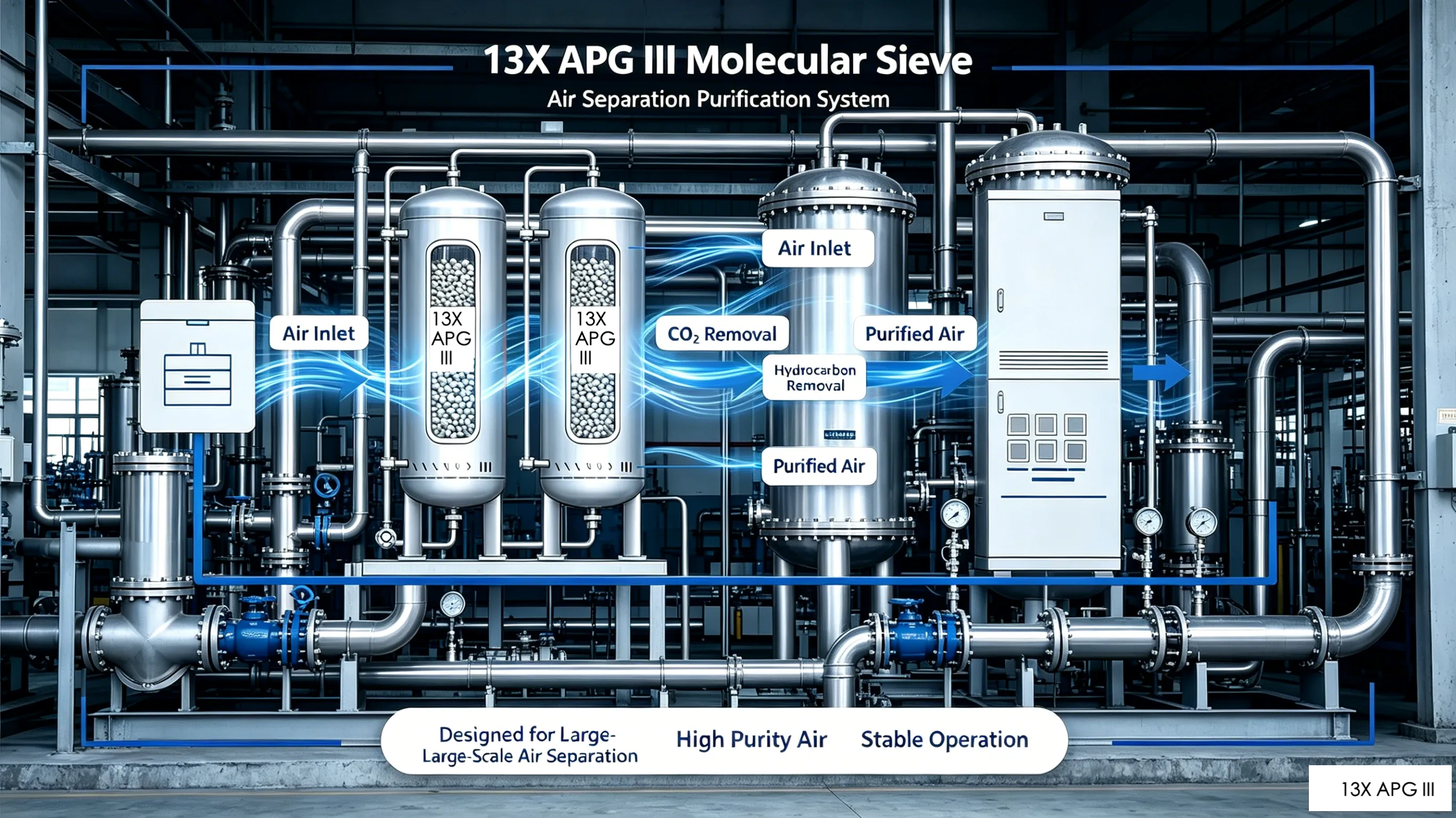
The emergence of 13X APG-III is precisely designed to end this compromise. As the third-generation high-efficiency grade within the 13X family, purpose-engineered for cryogenic air pre-purification (APPU), it is no longer merely a "consumable" but rather a technical asset that can be directly written into your project's return-on-investment (ROI) calculations.
Beyond "High Capacity": Molecular sieve APG-III's Leapfrog Advantages in key status
In technical procurement, data speaks louder than any marketing claim. Compared to traditional molecular sieve 13X and molecular sieve APG, Molecular sieve APG-III delivers a tier-jumping performance improvement across core indicators:
| Core status | Molecular sieve 13X APG | Molecular sieve 13X APG-III | Actual value for plant |
| Static CO₂ Adsorption | ~18.0 wt% | ≥21.0 wt% | Increase 22%~60% |
| Dynamic CO₂ Working Capacity | / | ~70% higher | Determines regeneration cycle and steam consumption |
| Crushing Strength | ~35 N/piece | ≥50 N/piece | Reduces attrition risk and extends service life |
After completing a purification system retrofit at a large coal-chemical ASU in China, the plant replaced zeolite 13X with molecular sieve 13X APG-III. Bed differential pressure dropped from 11 kPa to just 6.86 kPa. This single change saved 7,219 tons of steam annually, translating into nearly RMB 1 million in direct cost savings.
Why APG-III Let Your Equipment "Breathe" More Freely?
1. Cracking the "CO₂ Breakthrough" Bottleneck
The greatest fear in cryogenic air separation is CO₂ precipitating as "dry ice" within the plate-fin heat exchanger, causing channel blockages. APG-III maintains a CO₂ adsorption capacity of ≥21.0 wt% even at a partial pressure of 250 mmHg. This means that under identical operating conditions, the effective protection time of the adsorbent bed extends from 4 hours to 6 hours. Reducing the switching frequency by two cycles per day significantly minimizes temperature/pressure fluctuations and valve wear caused by frequent changeovers.
2. The "Longevity" Dividend of Crushing Strength
Many technical professionals focus on adsorption capacity while overlooking the critical importance of anti-attrition performance. The crush strength of APG-III ≥50N/piece, combined with an ultra-low attrition rate of ≤0.30%, means that over a 10~20 years’ equipment lifecycle, the frequency of "topping up" due to bed degradation—and the explosion risks associated with fines entering the main heat exchanger—are substantially reduced.
For new large-scale ASU projects: Adopting APG-III allows designers to reduce the purifier vessel dimensions, lowering capital equipment costs (CAPEX) while minimizing footprint. Thanks to its superior adsorption capacity, smaller regeneration heaters may even be specified under certain operating conditions.
For existing plant retrofits (Revamp): This is where APG-III delivers its most compelling "cost-reduction & efficiency-gain" story. As demonstrated in the case study above, by simply switching to APG-III and optimizing the regeneration protocol, energy savings of 15%–30% can be achieved without altering existing vessel dimensions. For plants facing carbon taxes and rising energy prices, this represents a high-return investment with an exceptionally short payback period (typically <1 year).
In an era of ever-shrinking margins in the air separation industry, every kilowatt-hour of electricity, every ton of steam, and every unplanned shutdown directly impacts your bottom-line competitiveness. 13X APG-III represents not merely an adsorbent technology upgrade, but a relentless pursuit of Lifecycle Cost (LCC) optimization.
It may not be the cheapest option upfront—but it is unquestionably the wisest investment. Because truly superior equipment saves you money in ways far more substantial than its price tag suggests.
Let your purification system breathe easier and run smoother. Molecular sieve 13X APG-III, let’s calculate the "cost-saving equation" for your next project.
In the cost structure of a cryogenic air separation unit (ASU), the energy consumption and maintenance expenditures of the purification system consistently command a significant share.Here is an open secret within the industry: the majority of ASU purification systems are operating on an "extended service" basis—still using molecular sieve products whose performance has long fallen behind modern process requirements.
The emergence of 13X APG-III is precisely designed to end this compromise. As the third-generation high-efficiency grade within the 13X family, purpose-engineered for cryogenic air pre-purification (APPU), it is no longer merely a "consumable" but rather a technical asset that can be directly written into your project's return-on-investment (ROI) calculations.
Beyond "High Capacity": Molecular sieve APG-III's Leapfrog Advantages in key status
In technical procurement, data speaks louder than any marketing claim. Compared to traditional molecular sieve 13X and molecular sieve APG, Molecular sieve APG-III delivers a tier-jumping performance improvement across core indicators:
| Core status | Molecular sieve 13X APG | Molecular sieve 13X APG-III | Actual value for plant |
| Static CO₂ Adsorption | ~18.0 wt% | ≥21.0 wt% | Increase 22%~60% |
| Dynamic CO₂ Working Capacity | / | ~70% higher | Determines regeneration cycle and steam consumption |
| Crushing Strength | ~35 N/piece | ≥50 N/piece | Reduces attrition risk and extends service life |
After completing a purification system retrofit at a large coal-chemical ASU in China, the plant replaced zeolite 13X with molecular sieve 13X APG-III. Bed differential pressure dropped from 11 kPa to just 6.86 kPa. This single change saved 7,219 tons of steam annually, translating into nearly RMB 1 million in direct cost savings.
Why APG-III Let Your Equipment "Breathe" More Freely?
1. Cracking the "CO₂ Breakthrough" Bottleneck
The greatest fear in cryogenic air separation is CO₂ precipitating as "dry ice" within the plate-fin heat exchanger, causing channel blockages. APG-III maintains a CO₂ adsorption capacity of ≥21.0 wt% even at a partial pressure of 250 mmHg. This means that under identical operating conditions, the effective protection time of the adsorbent bed extends from 4 hours to 6 hours. Reducing the switching frequency by two cycles per day significantly minimizes temperature/pressure fluctuations and valve wear caused by frequent changeovers.
2. The "Longevity" Dividend of Crushing Strength
Many technical professionals focus on adsorption capacity while overlooking the critical importance of anti-attrition performance. The crush strength of APG-III ≥50N/piece, combined with an ultra-low attrition rate of ≤0.30%, means that over a 10~20 years’ equipment lifecycle, the frequency of "topping up" due to bed degradation—and the explosion risks associated with fines entering the main heat exchanger—are substantially reduced.
For new large-scale ASU projects: Adopting APG-III allows designers to reduce the purifier vessel dimensions, lowering capital equipment costs (CAPEX) while minimizing footprint. Thanks to its superior adsorption capacity, smaller regeneration heaters may even be specified under certain operating conditions.
For existing plant retrofits (Revamp): This is where APG-III delivers its most compelling "cost-reduction & efficiency-gain" story. As demonstrated in the case study above, by simply switching to APG-III and optimizing the regeneration protocol, energy savings of 15%–30% can be achieved without altering existing vessel dimensions. For plants facing carbon taxes and rising energy prices, this represents a high-return investment with an exceptionally short payback period (typically <1 year).
In an era of ever-shrinking margins in the air separation industry, every kilowatt-hour of electricity, every ton of steam, and every unplanned shutdown directly impacts your bottom-line competitiveness. 13X APG-III represents not merely an adsorbent technology upgrade, but a relentless pursuit of Lifecycle Cost (LCC) optimization.
It may not be the cheapest option upfront—but it is unquestionably the wisest investment. Because truly superior equipment saves you money in ways far more substantial than its price tag suggests.
Let your purification system breathe easier and run smoother. Molecular sieve 13X APG-III, let’s calculate the "cost-saving equation" for your next project.
