Main Differences Between Carbon Molecular Sieves and Activated Carbon
Time:2026-05-15
With the continuous growth of global demand for industrial gas separation and purification, carbon molecular sieves and activated carbon, as two important carbon-based adsorption materials, are attracting increasing attention from export trade clients. However, in practical operations, the two items are often conflated. Although both are primarily composed of carbon, they differ fundamentally in pore structure, separation mechanisms, and core applications. Choosing the wrong material not only leads to inefficiency but also results in direct economic losses.
1.Pore Structure
* Carbon molecular sieve: It features an extremely narrow pore size distribution, concentrated between 0.3-1.0nm, matching the kinetic diameters of common gas molecules (e.g., N2 at 3.6 Å, O2 at 3.46 Å). This uniform microporous structure resembling a "molecular sieve" enables selective adsorption based on molecular size and shape.
* Activated carbon: The pore structure exhibits a broad distribution, encompassing micropores (<2nm), mesopores (2-50nm), and macropores (>50nm), resembling a "sponge." Although it possesses a large specific surface area (typically 500-1500m²/g), it lacks precise sieving capabilities.
Conclusion: Carbon molecular sieves are "precision sieves," while activated carbon is a "broad-spectrum absorption sponge".
2. Separation Feather
* Carbon molecular sieve: Based on kinetic separation. It utilizes the difference in diffusion rates of gas molecules in micropores to achieve separation. For example, in pressure swing adsorption (PSA) nitrogen production, oxygen molecules diffuse much faster than nitrogen, so the CMS preferentially adsorbs oxygen while nitrogen is enriched and output as the product gas. Its performance depends on the "rate difference" rather than the total adsorption capacity.
* Activated carbon: Based on equilibrium adsorption. It relies on van der Waals forces to adsorb various molecules, with adsorption capacity primarily determined by the concentration, polarity, and temperature of the adsorbate. It lacks a distinct "fast or slow" distinction, aiming instead for "maximum adsorption."
Conclusion: Carbon molecular sieves are used for "dynamic gas separation," while activated carbon is employed for "static impurity capture".
3.Core Application Scenarios: Distinct Industrial Roles
|
Item |
Carbon molecular sieve |
Activated carbon |
|
Shape |
Cylinder shape |
Irregular shape |
|
Typical application |
PSA nitrogen production (N2/O2 separation), methane purification etc |
waste gas adsorption, water quality purification, decolorization etc |
|
Output target |
Obtain high purity N2 over 99.99% |
remove pollutants and purify impurities |
|
Regeneration method |
atmospheric pressure |
analytical thermal regeneration |
|
Life time |
3-5 years, but it is greatly affected by oxygen and liquid water |
Usually 1-2 years, depending on the working conditions |
|
If customers want to produce N2 gas with a purity of 99.99% from compressed air, carbon molecular sieves are the first choice. If want to remove excess water vapor, oil, etc., activated carbon is an economical choice. |
||
4、 Misconceptions in selection -- An undeniable mistake
* Accidentally loading activated carbon into PSA nitrogen generator: Activated carbon lacks molecular sieving ability, which can lead to a sharp decrease in nitrogen purity and even damage to equipment valves. This is an irreversible error.
* Using carbon molecular sieves for water treatment: Carbon molecular sieves will quickly break and fail when exposed to water, and the cost far exceeds that of activated carbon, making it completely uneconomical.
* Neglecting pre-treatment requirements: Carbon molecular sieves are extremely sensitive to oil and liquid water, and the front-end must be equipped with an efficient purification system; Activated carbon is relatively tolerant to water vapor.
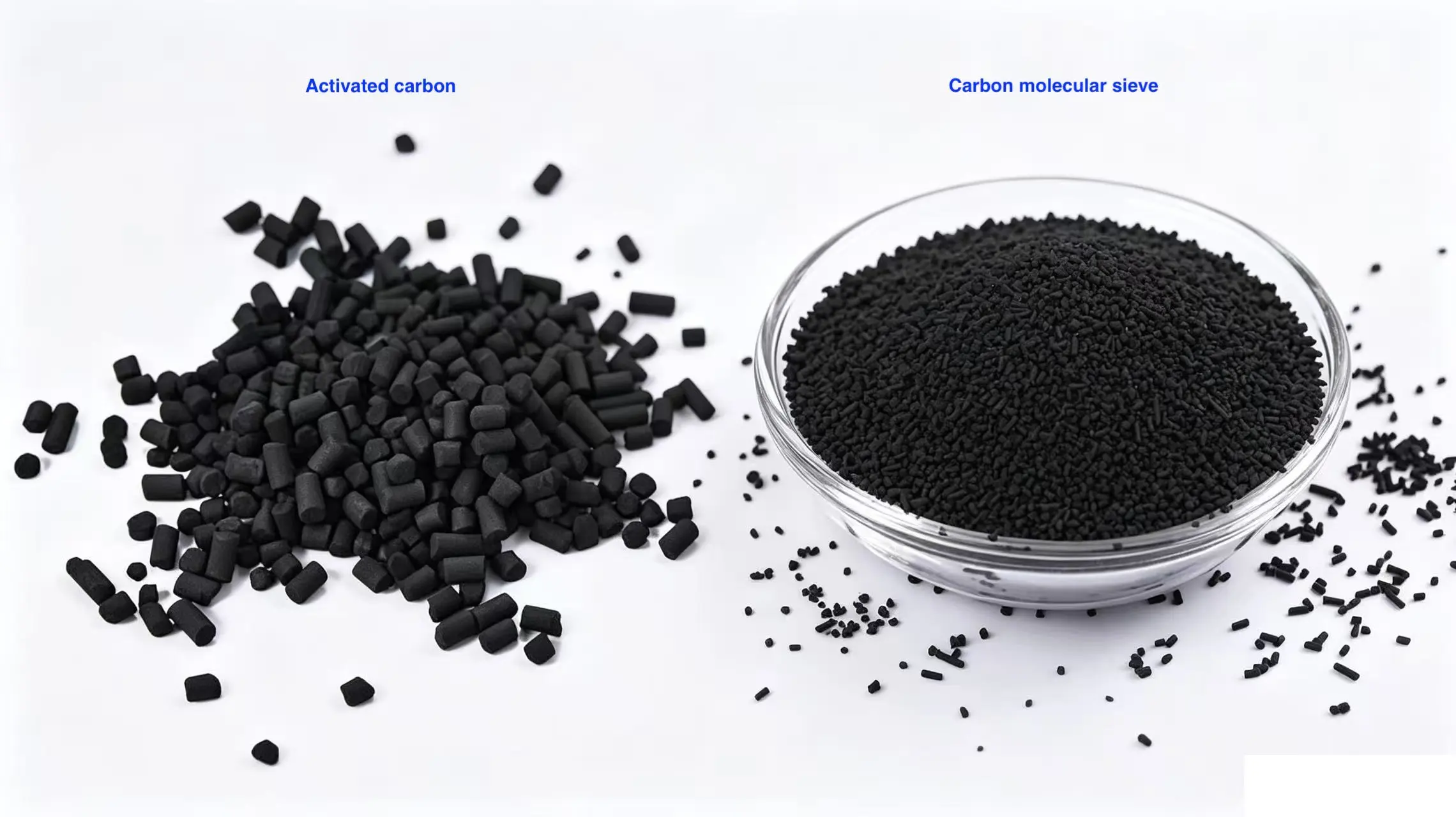
So, when our customers focus on "gas separation", such as extracting nitrogen/oxygen from air and purifying methane from biogas, we recommend carbon molecular sieves. When customers focus on "impurity removal", such as wastewater treatment, exhaust gas purification, solvent recovery, etc. Activated carbon is a more suitable and economical choice.
With the continuous growth of global demand for industrial gas separation and purification, carbon molecular sieves and activated carbon, as two important carbon-based adsorption materials, are attracting increasing attention from export trade clients. However, in practical operations, the two items are often conflated. Although both are primarily composed of carbon, they differ fundamentally in pore structure, separation mechanisms, and core applications. Choosing the wrong material not only leads to inefficiency but also results in direct economic losses.
1.Pore Structure
* Carbon molecular sieve: It features an extremely narrow pore size distribution, concentrated between 0.3-1.0nm, matching the kinetic diameters of common gas molecules (e.g., N2 at 3.6 Å, O2 at 3.46 Å). This uniform microporous structure resembling a "molecular sieve" enables selective adsorption based on molecular size and shape.
* Activated carbon: The pore structure exhibits a broad distribution, encompassing micropores (<2nm), mesopores (2-50nm), and macropores (>50nm), resembling a "sponge." Although it possesses a large specific surface area (typically 500-1500m²/g), it lacks precise sieving capabilities.
Conclusion: Carbon molecular sieves are "precision sieves," while activated carbon is a "broad-spectrum absorption sponge".
2. Separation Feather
* Carbon molecular sieve: Based on kinetic separation. It utilizes the difference in diffusion rates of gas molecules in micropores to achieve separation. For example, in pressure swing adsorption (PSA) nitrogen production, oxygen molecules diffuse much faster than nitrogen, so the CMS preferentially adsorbs oxygen while nitrogen is enriched and output as the product gas. Its performance depends on the "rate difference" rather than the total adsorption capacity.
* Activated carbon: Based on equilibrium adsorption. It relies on van der Waals forces to adsorb various molecules, with adsorption capacity primarily determined by the concentration, polarity, and temperature of the adsorbate. It lacks a distinct "fast or slow" distinction, aiming instead for "maximum adsorption."
Conclusion: Carbon molecular sieves are used for "dynamic gas separation," while activated carbon is employed for "static impurity capture".
3.Core Application Scenarios: Distinct Industrial Roles
|
Item |
Carbon molecular sieve |
Activated carbon |
|
Shape |
Cylinder shape |
Irregular shape |
|
Typical application |
PSA nitrogen production (N2/O2 separation), methane purification etc |
waste gas adsorption, water quality purification, decolorization etc |
|
Output target |
Obtain high purity N2 over 99.99% |
remove pollutants and purify impurities |
|
Regeneration method |
atmospheric pressure |
analytical thermal regeneration |
|
Life time |
3-5 years, but it is greatly affected by oxygen and liquid water |
Usually 1-2 years, depending on the working conditions |
|
If customers want to produce N2 gas with a purity of 99.99% from compressed air, carbon molecular sieves are the first choice. If want to remove excess water vapor, oil, etc., activated carbon is an economical choice. |
||
4、 Misconceptions in selection -- An undeniable mistake
* Accidentally loading activated carbon into PSA nitrogen generator: Activated carbon lacks molecular sieving ability, which can lead to a sharp decrease in nitrogen purity and even damage to equipment valves. This is an irreversible error.
* Using carbon molecular sieves for water treatment: Carbon molecular sieves will quickly break and fail when exposed to water, and the cost far exceeds that of activated carbon, making it completely uneconomical.
* Neglecting pre-treatment requirements: Carbon molecular sieves are extremely sensitive to oil and liquid water, and the front-end must be equipped with an efficient purification system; Activated carbon is relatively tolerant to water vapor.
So, when our customers focus on "gas separation", such as extracting nitrogen/oxygen from air and purifying methane from biogas, we recommend carbon molecular sieves. When customers focus on "impurity removal", such as wastewater treatment, exhaust gas purification, solvent recovery, etc. Activated carbon is a more suitable and economical choice.
